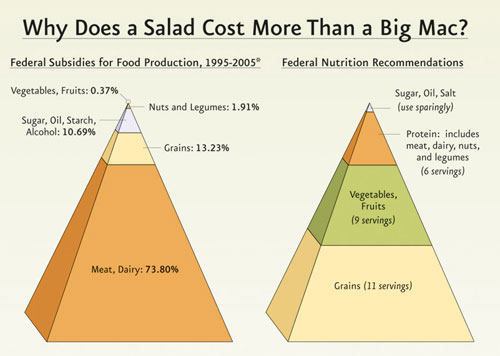
With food prices soaring, it takes some gall to force Americans to pay billions of dollars to millionaire agribusinesses. Yet that's what the latest farm bill would do.
{xtypo_quote_right} Farm subsidies don't produce food, but they do produce votes. Despite its economic incoherence, the farm agreement is overwhelmingly popular in a Congress that has mastered the art of distributing tax dollars to favored industries. {/xtypo_quote_right}
Since the last farm bill was enacted in 2002, the five crops that receive the lion's share of farm subsidies have also enjoyed massive price increases: cotton (105 percent price increase), soybeans (164 percent), corn (169 percent), wheat (256 percent) and rice (281 percent). For consumers, these price increases have caused financial pain domestically and near-riots abroad. For farmers, it's a sunnier story: Total net farm income has leaped 56 percent in just two years, and helped bring the average farm household's income to a record $89,434, and its net worth to $838,875.
During this crop-price boom, continuing to subsidize farmers makes as much sense as paying Apple to make another generation of iPods.
Yet instead of cutting, Congress' answer is to harvest even more farm subsidies. The latest version would increase payment rates for more than a dozen crops and increase conservation subsidies. Although the same farmers already receive massive annual subsidies, plus taxpayer-funded crop insurance, Congress would also layer a new permanent disaster aid program. Expect Congress to declare an emergency any week that it rains - or doesn't rain.

www.malaymail.com/news/world/2026/01/11/bomb-attac…

BANGKOK, Jan 11 — A series of late-night bomb attacks targeted 11 PTT petrol stations in Thailand’s southern border provinces of Narathiwat, Pattani and Yala…
www.khaama.com/at-least-eight-refugees-die-37-resc…

At least eight refugees died and 37 were rescued when their boat sank off Badmeli near Izmir, Turkish authorities said on Saturday.
katu.com/news/local/oregon-confirms-first-measles-…

Health officials in Oregon have confirmed the state's first measles cases of 2026, with two people diagnosed in Linn County.
abc11.com/post/measles-north-carolina-state-report…

Measles in North Carolina: State reports 5th case linked to South Carolina surge