Super Strong Magnetic Fields Imprint Nuclear Matter
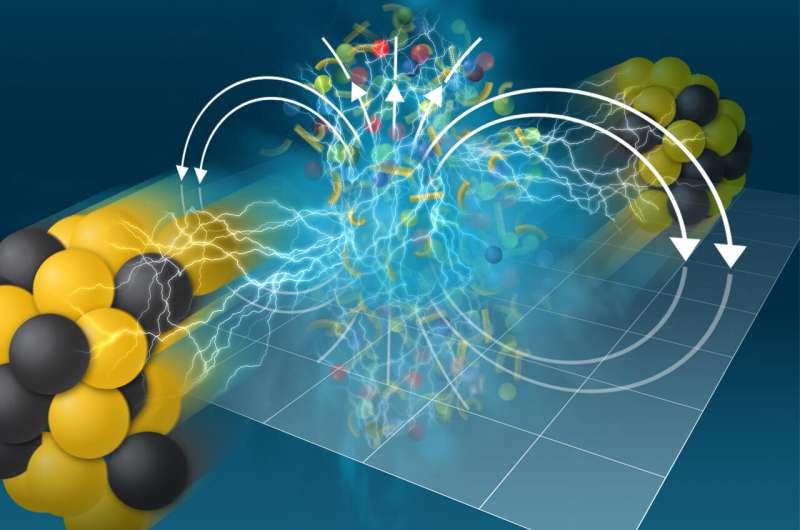 Collisions of heavy ions generate an immensely strong electromagnetic field. Scientists investigate traces of this powerful electromagnetic field in the quark-gluon plasma (QGP), a state where quarks and gluons are liberated from the colliding protons and neutrons. Credit: Tiffany Bowman and Jen Abramowitz/Brookhaven National Laboratory.
Karen McNulty Walsh, Peter Genzer -- Brookhaven National Laboratory
Feb. 23, 2024
Super strong magnetic fields leave an imprint on nuclear matter.
A new analysis by the STAR collaboration at the Relativistic Heavy Ion Collider (RHIC), a particle collider at the U.S. Department of Energy's (DOE) Brookhaven National Laboratory, provides the first direct evidence of the imprint left by what may be the universe's most powerful magnetic fields on "deconfined" nuclear matter.
The evidence comes from measuring the way differently charged particles separate when emerging from collisions of atomic nuclei at this DOE Office of Science user facility.
As described in the journal Physical Review X, the data indicate that powerful magnetic fields generated in off-center collisions induce an electric current in the quarks and gluons set free, or deconfined, from protons and neutrons by the particle smashups.
The findings give scientists a new way to study the electrical conductivity of this "quark-gluon plasma" (QGP) to learn more about these fundamental building blocks of atomic nuclei.
(more)
- CategoriesEdited | Front Page Stories | All Content | Education | Energy | Government | Science | Technology | North America | News | News -- WNT Selected
- Date rangeSunday, February 25, 2024
- Last modifiedSunday, February 25, 2024
