Physicist explores the possibility of vestiges of a universe previous to the Big Bang | Peter Moon
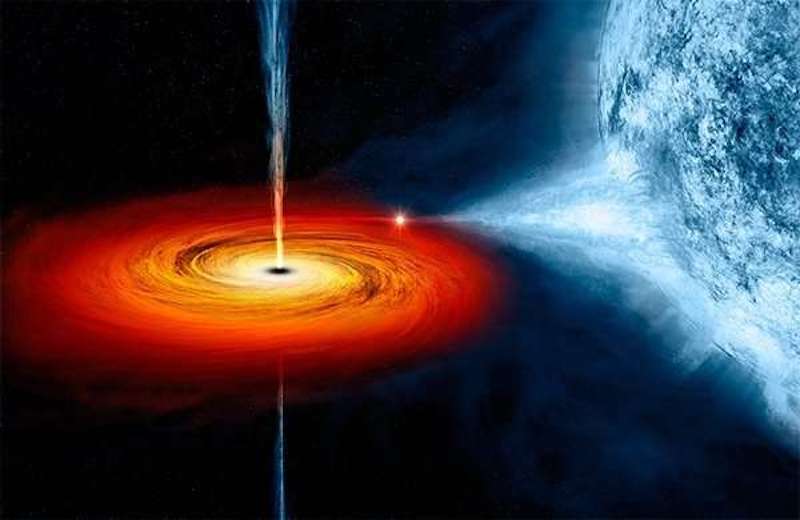 Physicist publishes paper in General Relativity and Gravitation proposing to eliminate need for cosmological spacetime singularity and arguing that the current expansion phase was preceded by contraction. Credit: NASA / CXC / M. Weiss
Nov. 28 2017 (Phys.org) -- The Big Bang theory is the best known and most accepted explanation for the beginning and evolution of the universe, but it is hardly a consensus among scientists.
Brazilian physicist Juliano Cesar Silva Neves is part of a group of researchers who dare to imagine a different origin. In a study recently published in the journal General Relativity and Gravitation, Neves suggests the elimination of a key aspect of the standard cosmological model: The need for a spacetime singularity known as the Big Bang.
In raising this possibility, Neves challenges the idea that time had a beginning and reintroduces the possibility that the current expansion was preceded by contraction. "I believe the Big Bang never happened," the physicist said, who works as a researcher at the University of Campinas's Mathematics, Statistics & Scientific Computation Institute (IMECC-UNICAMP) in Sao Paulo State, Brazil.
For Neves, the fast spacetime expansion stage does not exclude the possibility of a prior contraction phase. Moreover, the switch from contraction to expansion may not have destroyed all traces of the preceding phase.
(more)
- CategoriesEdited | Front Page Stories | All Content | Science | North America | South America | Space | News | News -- WNT Selected | Slider
- Date rangeTuesday, November 28, 2017
- Last modifiedWednesday, November 29, 2017
